SELECT * FROM ggsql:airquality
VISUALISE Epoch AS x, Temp AS y
DRAW point
DRAW smooth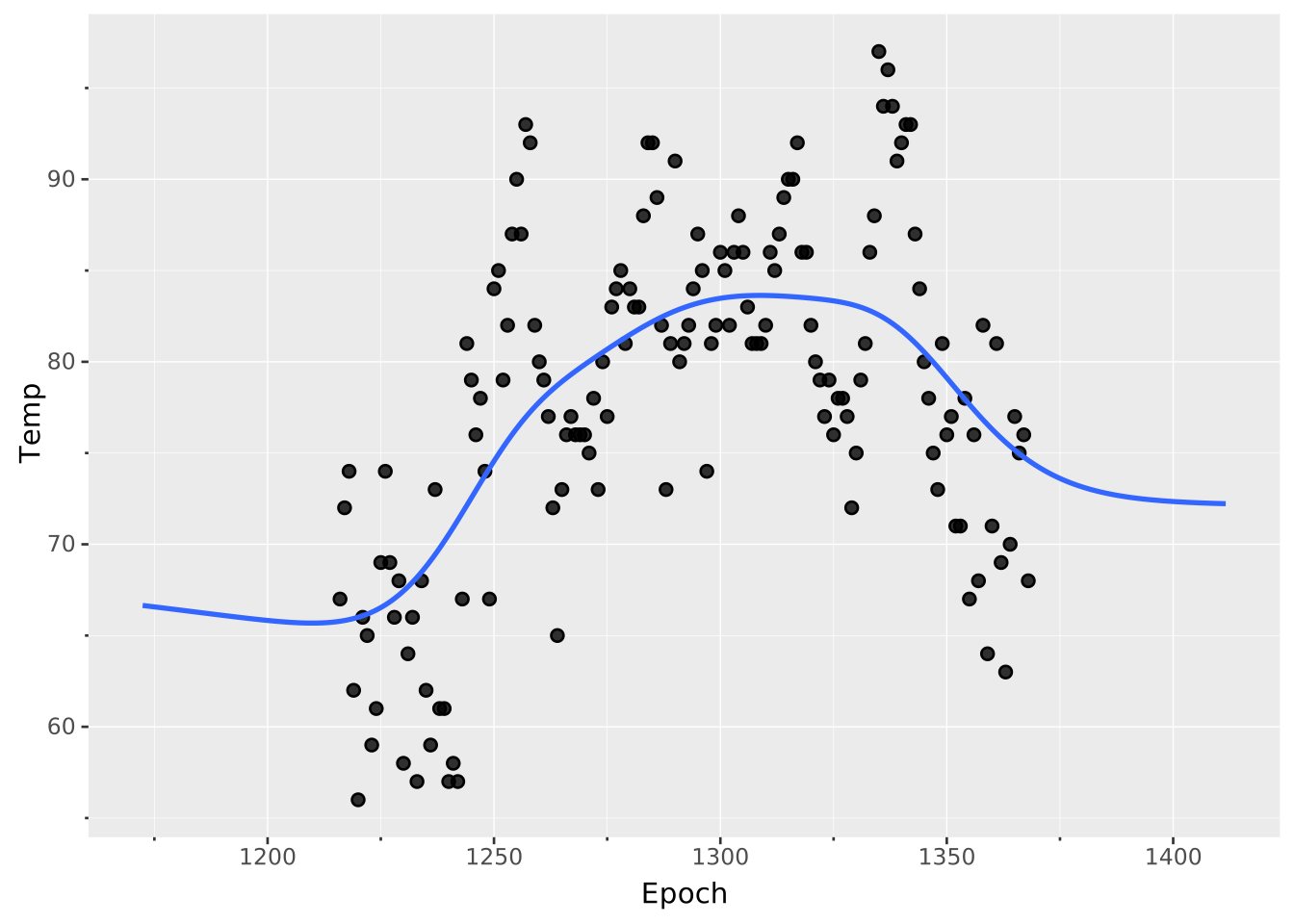
Layers are declared with the
DRAWclause. Read the documentation for this clause for a thorough description of how to use it.
Smooth layers are used to display a trendline among a series of observations.
x): Position along the primary axis.y): Position along the secondary axis.colour/stroke: The colour of the lineopacity: The opacity of the linelinewidth: The width of the linelinetype: The type of line, i.e. the dashing patternmethod: Choice of the method for generating the trendline. One of the following:
'nw' or 'nadaraya-watson' estimates the trendline using the Nadaraya-Watson kernel regression method (default).'ols' estimates a straight trendline using ordinary least squares method.'tls' estimates a straight trendline using total least squares method.The settings below only apply when method => 'nw' and are ignored when using other methods. * bandwidth: Smoothing bandwidth (must be > 0). If absent (default), the bandwidth will be computed using Silverman’s rule of thumb. * adjust: Multiplier for the bandwidth setting (must be > 0). Defaults to 1. * kernel: Determines the smoothing kernel shape. Can be one of the following: * 'gaussian' (default) * 'epanechnikov' * 'triangular' * 'rectangular' or 'uniform' * 'biweight' or 'quartic' * 'cosine'
The default method => 'nw' computes a locally weighted average of \(y\).
\[ y(x) = \frac{\sum_{i=1}^nW(x)y_i}{\sum_{i=1}^nW(x)} \]
Where:
Please note the similarity of \(W(x)\) to the kernel density estimation formula.
The method => 'ols' setting uses ordinary least squares to compute the intercept \(a\) and slope \(b\) of a straight line. The method minimizes the 1-dimensional distance between a point and the vertical projection of that point on the line. Only considering the vertical distances implies having measurement error in \(y\), but not \(x\).
\[ y = a + bx \]
Wherein:
\[ a = E[Y] - bE[X] \]
and
\[ b = \frac{\text{cov}(X, Y)}{\text{var}(X)} = \frac{E[XY] - E[X]E[Y]}{E[X^2]-(E[X])^2} \]
The method => 'tls' setting uses total least squares to compute the intercept \(a\) and slope \(b\) of a straight line. The method minimizes the 2-dimensional distance between a point and the perpendicular projection of that point on the line. Minimising the perpendicular distances (rather than just the vertical distances) makes sense if there is uncertainty or measurement error in not just \(y\), but in \(x\) as well. In such case, it is a more accurate depiction of the relationship between \(x\) and \(y\), but it isn’t the best predictor of \(y\) given \(x\).
\[ y = a + bx \]
Wherein:
\[ a = E[Y] - bE[X] \]
and
\[ b = \frac{\text{var}(Y) - \text{var}(X) + \sqrt{(\text{var}(Y) - \text{var}(X))^2 + 4\text{cov}(X, Y)^2}}{2\text{cov}(X, Y)} \]
weight is available when using method => 'nw', where when mapped, it sets the relative contribution of an observation \(w_i\) to the average.intensity corresponds to \(y\) in the formulas described in the data transformation section.intensity AS y: By default the smooth layer will display the \(y\) in the formulas along the y-axis.The default method => 'nw' might be too coarse for timeseries.
SELECT * FROM ggsql:airquality
VISUALISE Epoch AS x, Temp AS y
DRAW point
DRAW smooth
You can make the fit more granular by reducing the bandwidth, for example using adjust.
SELECT * FROM ggsql:airquality
VISUALISE Epoch AS x, Temp AS y
DRAW point
DRAW smooth
  SETTING adjust => 0.2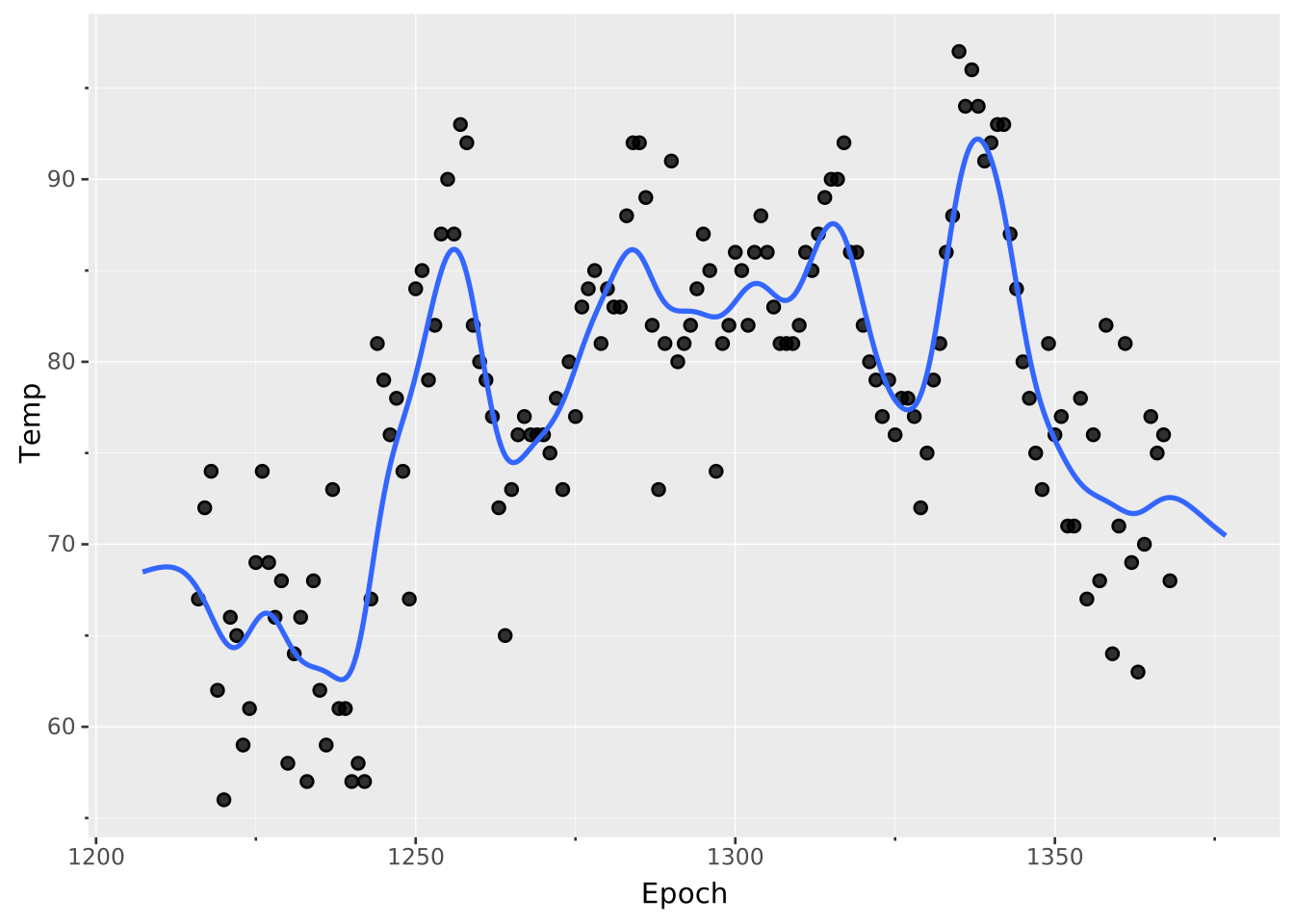
There is a subtle difference between the ordinary and total least squares method.
VISUALISE bill_len AS x, bill_dep AS y FROM ggsql:penguins
DRAW point
DRAW smooth
  MAPPING 'Ordinary' AS colour
  SETTING method => 'ols'
DRAW smooth
  MAPPING 'Total' AS colour
  SETTING method => 'tls'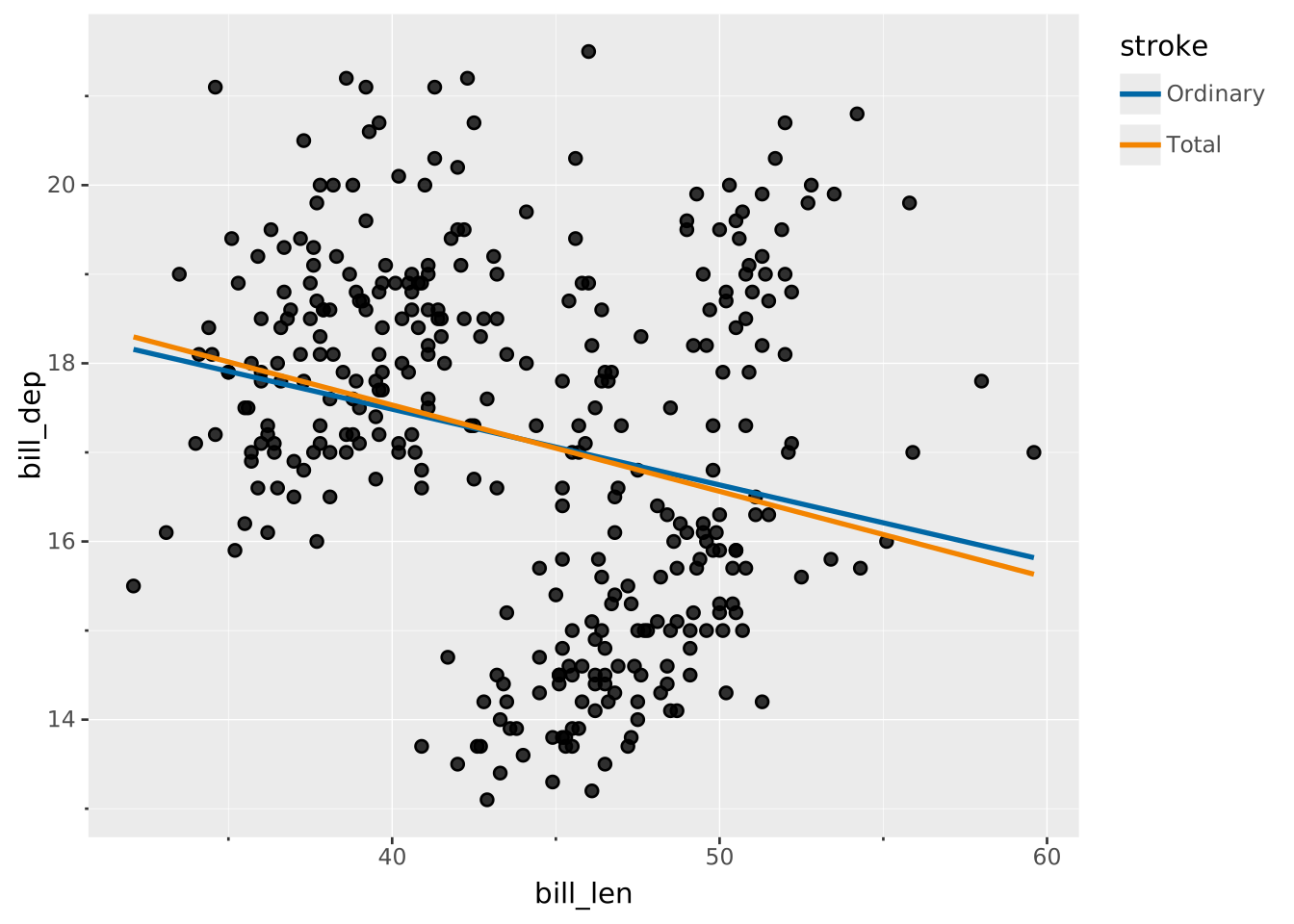
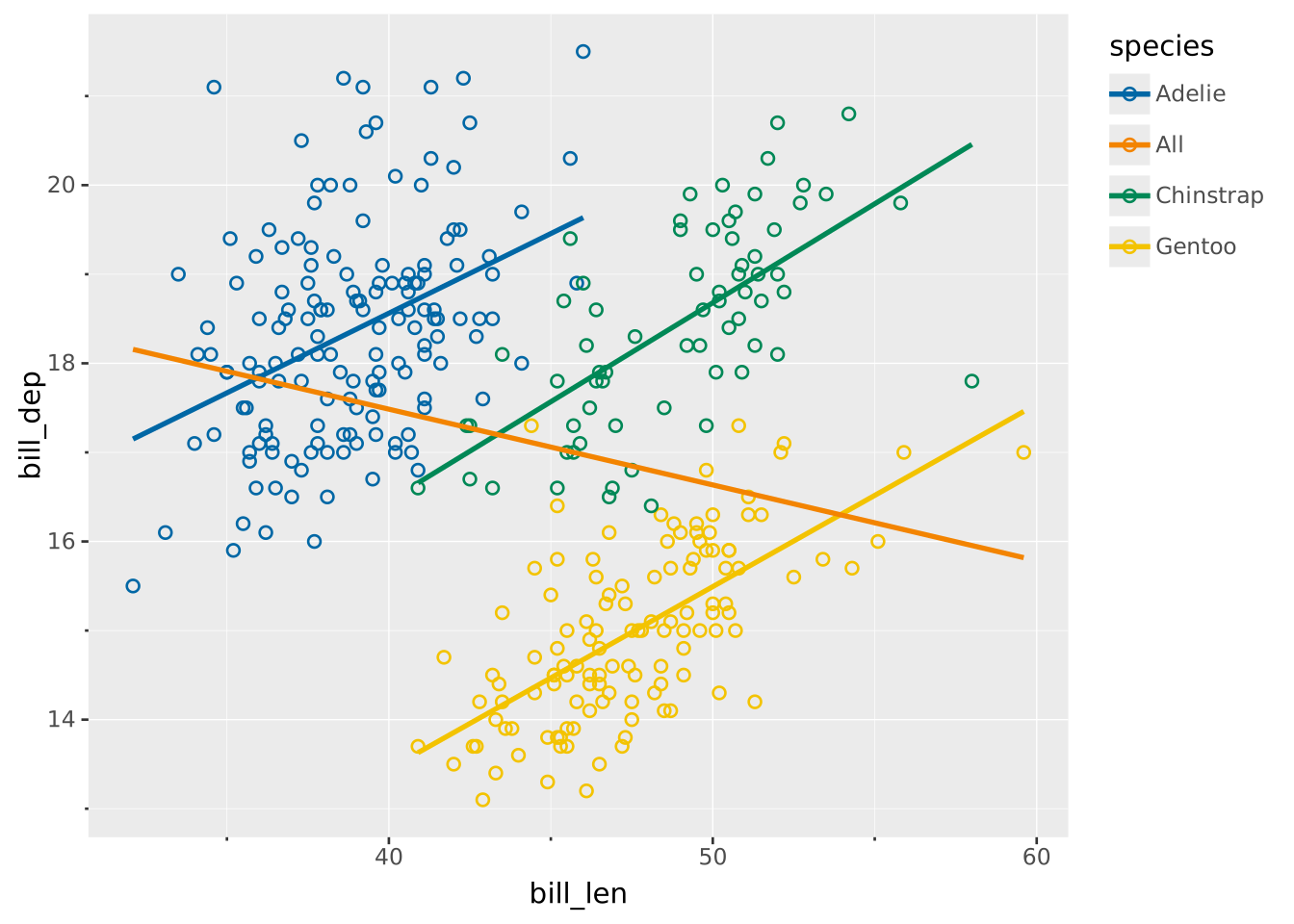
Simpson’s Paradox is a case where a trend of combined groups is reversed when groups are considered separately.
VISUALISE bill_len AS x, bill_dep AS y, species AS stroke FROM ggsql:penguins
DRAW point
  SETTING opacity => 0
DRAW smooth
  SETTING method => 'ols'
DRAW smooth
  MAPPING 'All' AS stroke
  SETTING method => 'ols'