Linetype
The linetype aesthetic defines the stroke pattern of lines: a succession of “on” and “off” parts of the line to make different stipple patterns. Linetype is most useful for line and path layers as a colorless way to differentiate between categories.
While linetypes are most useful for differentiating between discrete data, ggsql also comes with a sequential palette that gradually increases the amount of ink used for the pattern.
Literal values
Linetypes can be specified in two different ways. A couple of patterns are named and can be referred to as such:
| Name | Pattern | Stroke-dasharray | Description |
|---|---|---|---|
solid |
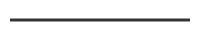 |
(none) | Continuous solid line |
dashed |
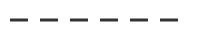 |
6 4 | Standard dashed line |
dotted |
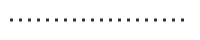 |
1 2 | Dotted line |
dotdash |
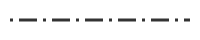 |
1 2 6 2 | Alternating dot and dash |
longdash |
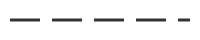 |
10 4 | Long dashes |
twodash |
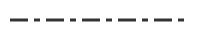 |
6 2 2 2 | Two different dash lengths |
You can e.g. use these names when defining a manual palette for the scale:
SCALE linetype TO ('dashed', 'dotted', 'twodash')You can alternatively specify a custom pattern using hex strings:
SCALE linetype TO ('44', '1343', '3c6c9c')Each pair of hex digits represents on/off lengths:
'44'= 4 on, 4 off (50% ink, similar to dashed)'1343'= 1 on, 3 off, 4 on, 3 off (dot-dash pattern)'3c6c9c'= 3 on, 12 off, 6 on, 12 off, 9 on, 12 off
Valid hex patterns:
- Must have 2, 4, 6, or 8 hex digits
- Digits can be 1-9 or a-f (0 is not allowed)
- Digits represent line lengths as multiples of the linewidth
Palettes
ggsql provides two linetype palettes which are generally enough for every need
The categorical palette is the default palette for discrete linetype scales. It consists of the 6 named patterns shown above in the same order. Since it is the only palette for discrete linetypes, there is rarely a need to specify it.
Sequential palette
The sequential palette is the default for binned and ordinal linetype scales. It consists of up to 15 patterns with increasing amount of “on” and decreasing amount of “off”. This creates a visual progression from sparse (low ink) to solid (100% ink).
Example: 5-level sequential
| Level | Pattern | Ink Density | Description |
|---|---|---|---|
| 1 |  |
~6% | Sparse dots |
| 2 | 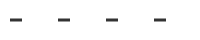 |
~29% | Short dashes |
| 3 | 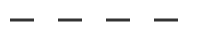 |
~52% | Medium dashes |
| 4 | 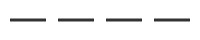 |
~75% | Long dashes |
| 5 | |
100% | Solid |
Accessibility
- Linetypes work well for colorblind viewers
- Combine with color for redundant encoding
- Limit to 4-6 distinct linetypes for readability
- Solid lines are most visible; use for primary data